 Local, Watershed-Based Representation Matters
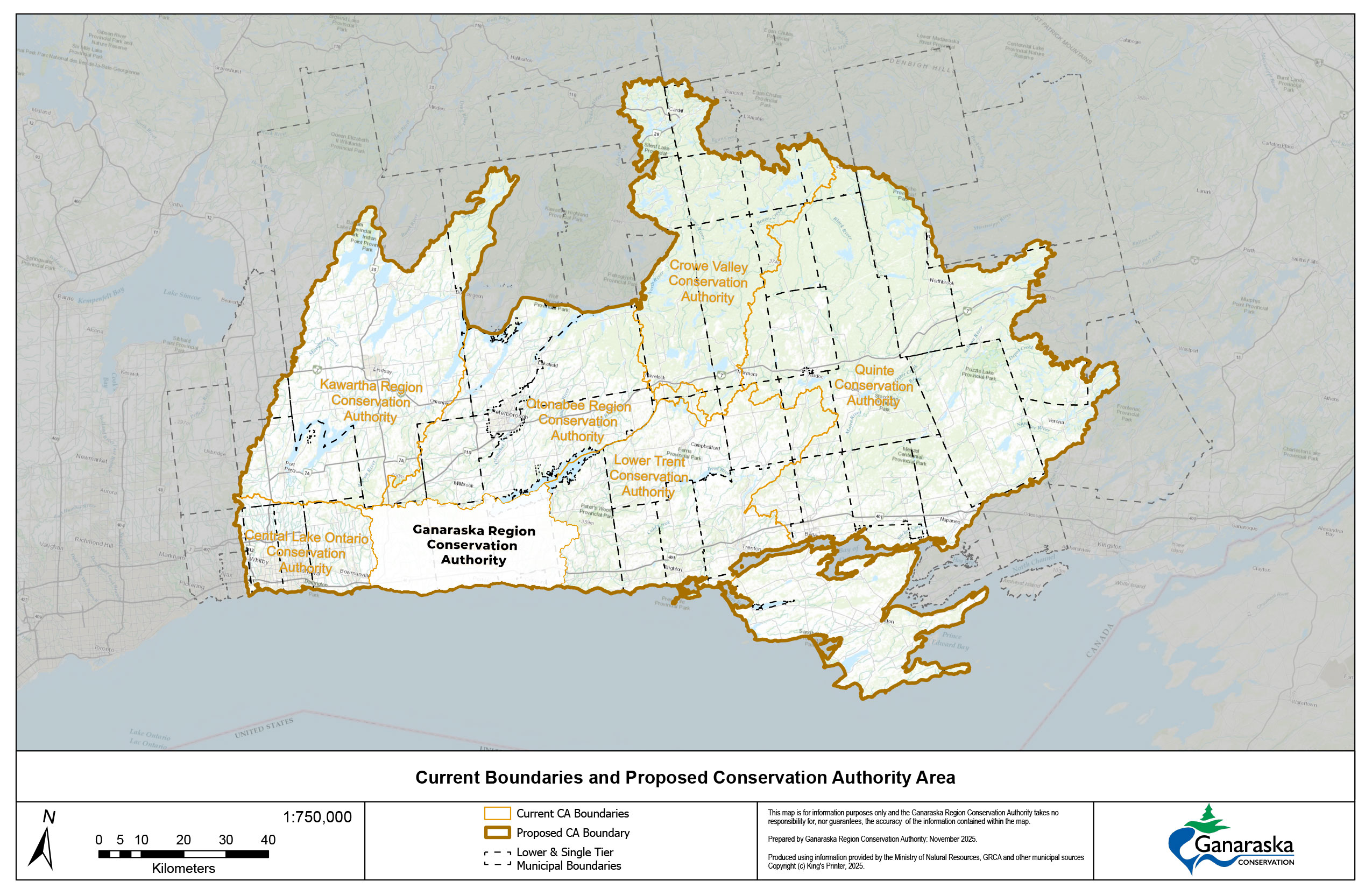
The Province is proposing consolidating Ontario’s 36 local Conservation Authorities into seven Regional Authorities.
As proposed, the Ganaraska Region Conservation Authority (GRCA) would become part of the Eastern Lake Ontario Regional Conservation Authority (ELORCA), which will include 48 municipalities across the proposed region. The planned ELORCA jurisdiction will be 16 times the size of the current GRCA jurisdiction, covering an area larger than the island of Jamaica and including a population larger than some Canadian Provinces.
The GRCA Board of Directors supports the desired outcome of improved consistency of watershed management BUT are concerned with the potential loss of local voices and representation within the proposed regional conservation authorities.
During their November 27, 2025, meeting, the GRCA Board received a staff report and presentation entitled, Bill 68, Schedule 3, Proposed Changes to the Conservation Authorities Act and proposed Boundaries for Regional Consolidation of Ontario Conservation Authorities, available here. As a result, the GRCA Board of Directors voted unanimously to oppose the consolidated Eastern Lake Ontario Region Conservation Authority (ELORCA) proposed by the Government of Ontario.
The presentation detailed the proposed consolidation that was initially announced by Minister of the Environment, Conservation and Parks (MECP) Todd McCarthy, on October 31, 2025. The Minister said the provincial government planned to introduce legislation to amend the Conservation Authorities Act, creating a new provincial agency, the Ontario Provincial Conservation Agency (OPCA), which would provide centralized leadership, efficient governance, strategic direction and oversight of Ontario’s 36 Conservation Authorities (CAs), while consolidating them into seven regional authorities.
The legislation introduced, Bill 68, Plan to Protect Ontario Act (Budget Measures), 2025 (No. 2), received Royal Assent on November 27, 2025.
On November 7th, the MECP posted Environmental Registry Notice No. 025-1257 (Proposed Boundaries for the Regional Consolidation of Ontario’s Conservation Authorities) to gather public input. The ERO posting remains open for public comment for a total of 45 days, until December 22, 2025, at 11:59 p.m.
PROPOSED CONSOLIDATION
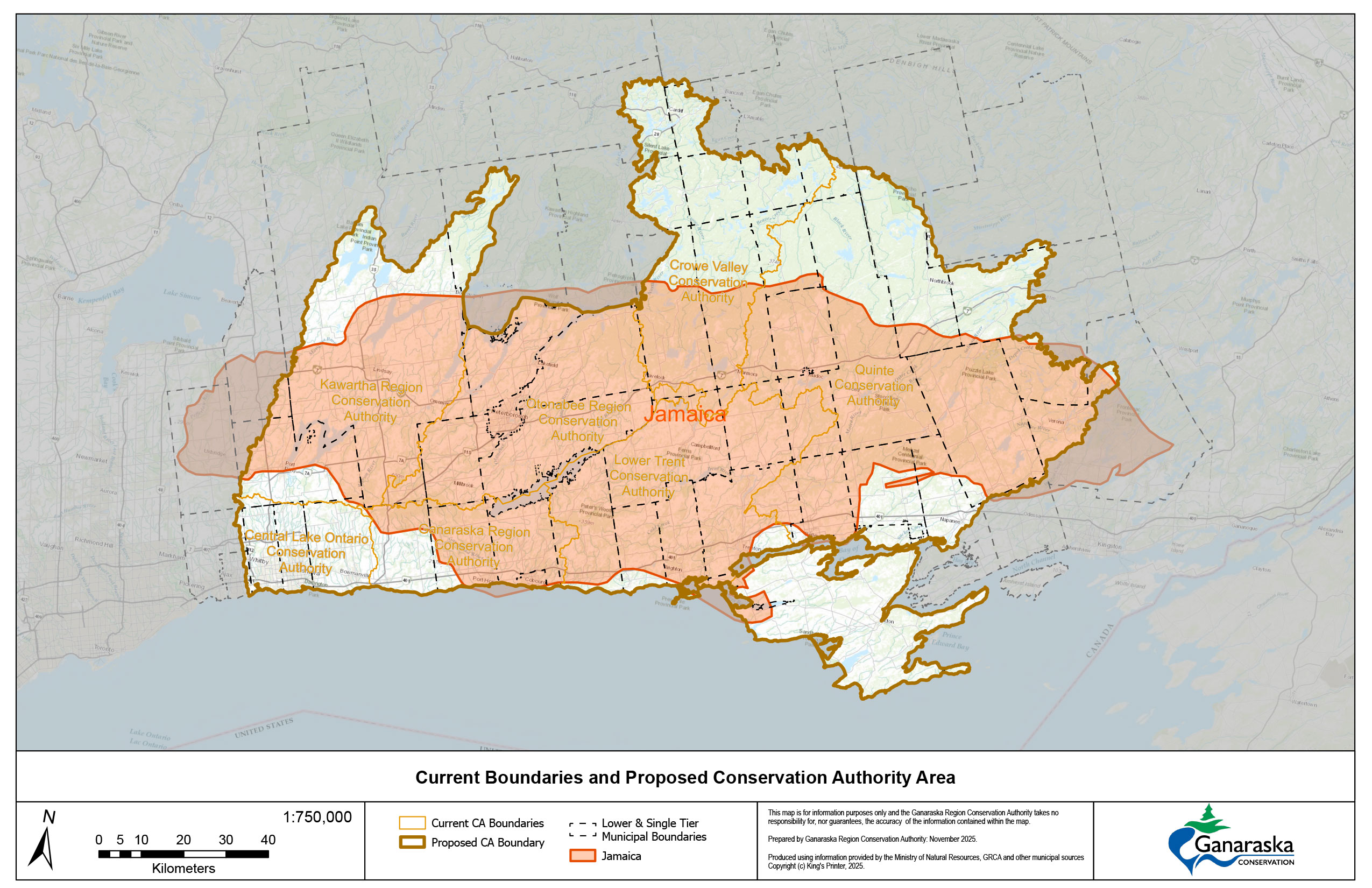
The proposed consolidation recommends the Ganaraska Region Conservation Authority join with six other conservation authorities, including Central Lake Ontario, Kawartha Region, Otonabee Region, Lower Trent Region, Crowe Valley and Quinte Region Conservation Authorities, to form the Eastern Lake Ontario Region Conservation Authority (ELORCA).
This consolidation will include 48 municipalities across the proposed region, a jurisdiction 16 times the size of the current GRCA jurisdiction, covering an area larger than the island of Jamaica, while including a population larger than some Canadian Provinces.
ACTION TAKEN BY GRCA BOARD
After receiving the report and presentation, the GRCA Board of Directors voted to support the following resolution, as written in the report:
Resolution GRCA 50/25
Moved By: Joan Stover
Seconded By: Miriam Mutton
WHEREAS the Ganaraska Region Conservation Authority Board of Directors acknowledges and supports the Province’s goals of improved efficiency of watershed management, through the implementation of digital applications and permitting system, consistent policies, flood standards, fees, and technology; and
WHEREAS consistent policies, and resources across the existing conservation authority boundaries could be achieved without structural consolidation through direction and tools such as technical guidelines provided by the Ministry of the Environment, Conservation and Parks; or Conservation Ontario; and
WHEREAS conservation authorities are locally-based, grassroots organizations formed by municipal governments in response to the challenges posed by a changing landscape; especially, the increased exposure to flooding and erosion hazards and the resulting risks to lives and property. In the case of the GRCA, supported by its seven municipalities, this vision has proven a successful model for nearly 80 years; and
WHEREAS the GRCA, with the guidance and support of our seven member municipalities, demonstrates fiscal prudence in conservation delivery, ensuring stable growth through stable funding. GRCA has successfully leveraged funding to support programs and services that are locally important and are driven by community engagement through GRCA’s Conservation Land Strategy and the Watershed Based Resource Management Strategy; and
WHEREAS GRCA consistently meets or exceeds provincial service standards, and participates in staff-sharing initiatives with neighbouring conservation authorities that already deliver many of the efficiencies the Province seeks; and
WHEREAS plans to regionalize conservation authorities through consolidation would dilute local accountability and municipal partnership and is contrary to the basic principle that decisions are best made closest to the communities they affect. Effective representation by municipal partners remains core to the success of conservation authorities. The GRCA, while not unique among conservation authorities in this respect, is effective in working with our community to support sustainable development, and keeping communities safe; and
WHEREAS being front-line means being responsive and accountable to the community by delivering the services that are essential and valued to the best interest of the community. The front line of provincial priorities on housing, the economy, infrastructure, and climate resilience are in the decisions between municipalities working together to address issues around floodplain (and hazard) protection and resilient upland and landscape management. Further, staff and Board are responsive and accountable to the needs of the watershed community, while meeting or exceeding provincial service standards. The staff and Board are reachable through publicly available contact information. Local governance and direction combined with local service provision allows the GRCA to continue to be responsive to our community; and
WHEREAS consolidation will result in substantial transition costs, not the least of which is time. In all facets, that would divert resources from front-line service delivery and delay desired outcomes. Further, the loss of local watershed knowledge and community relationships will add greater uncertainty, loss of trust, and delay for our watershed residents. This includes the agricultural community, businesses, builders, developers, and our municipal partners that seek timely and effective local advice, which is provided through local pre-consultation; and
WHEREAS a proposed regional watershed would create a geographically vast and administratively complex organization when joining the seven conservation authorities as proposed in eastern Lake Ontario. This would be considerably worse if local offices do not remain available and accountable to its membership, partners and the communities they serve.
THEREFORE BE IT RESOLVED:
THAT the Ganaraska Region Conservation Authority Board of Directors does not support the proposed “Eastern Lake Ontario Regional Conservation Authority” boundary configuration as outlined in Environmental Registry Notice 025-1257; and
FURTHER THAT meaningful modernization can occur within the current watershed-based governance framework; and
FURTHER THAT the GRCA Board endorses further provincial evaluation of a more focused specific model as a geographically coherent, cost-effective and locally accountable alternative that advances the government’s priorities of efficiency, red-tape reduction and timely home construction; and
FURTHER THAT the Board asks that the Ministry of the Environment, Conservation and Parks engage directly with affected municipalities and conservation authorities across Eastern Lake Ontario through a working group; and
FURTHER THAT the Board of Directors direct staff to make a submission to the Environmental Registry of Ontario consultations asking the Province to pause any consolidation until more consultation can take place; and
FURTHER THAT a letter from the Chair containing this resolution, be forwarded to:
- The Minister of the Environment, Conservation and Parks and his Opposition critics; and
- The Ministry of the Environment, Conservation and Parks (CA Office); and
- Ontario’s Chief Conservation Executive, Hassaan Basit; and
- Local Member of Provincial Parliament David Piccini, Northumberland – Peterborough South and
- All local watershed municipalities, all municipalities in Ontario, and Counties within GRCA’s watershed.
CARRIED UNANIMOUSLY.
The GRCA encourages all partners and concerned residents to review the posting at the following link (https://ero.ontario.calnotice/025-1257) and submit comments prior to the closing date of December 22, 2025.
-30-
For additional information, please contact info@grca.on.ca or call 905.885.8173 during office hours, Mon.–Fri. from 8:30 a.m. to 4:30 p.m.
——
BACKGROUND
Protecting human life and property, while improving the overall watershed health for the benefit of local communities is primary to Conservation Authorities. Watershed-based management, recognized internationally as the most effective means of balancing environmental, economic and societal needs, is a founding principle in the formation of Ontario’s Conservation Authorities (CAs).
Ontario’s CAs are locally-based, grassroots organizations formed by municipal governments in response to the challenges posed by a changing landscape, especially the increased flooding and erosion hazards and resulting risks to human life and property. For the GRCA, supporting our seven municipalities has proven a successful model since 1946.
With the guidance and support of our seven municipalities, the GRCA has demonstrated fiscal prudence in conservation delivery, ensuring stable growth through stable funding, as well as successfully leveraging funding to support locally-important programs and services driven by community engagement through the GRCA’s Conservation Land Strategy and Watershed-Based Resource Management Strategy.
For nearly 80 years, Ontario’s Conservation Authorities have provided a broad range of essential services, including:
- Flood forecasting and warning
- Management of flood and erosion control infrastructure
- Natural hazard permitting and review
- Drinking water source protection
- Low water response coordination
- Maintenance of conservation areas and trails
- Outdoor and environmental education
- Implementation of restoration and climate change-related projects.
In 1946, after years of environmental degradation and severe flooding throughout Ontario, the Conservation Authorities Act was created to provide science-based advice to municipalities, on a watershed-basis — the GRCA was the third CA created in October of 1946.
Foundational to the modern conservation movement, the Ganaraska Watershed Report was an extensive study of the Ganaraska Region, detailing years of environmental degradation culminating in regular, devastating floods. The study was the largest its kind for the time, recommending the formation of the province’s Conservation Authorities.
Further calls for floodplain regulation and flooding-related powers for Conservation Authorities came in the wake of Hurricane Hazel, in 1954. Years later, in 1980, Port Hope experienced its largest flooding event to date, leading to the GRCA’s involvement in channelizing the lower portion of the Ganaraska River to mitigate future flooding events.
Since 1947, the continued restoration of the Ganaraska Forest has been key to reducing flooding in the Ganaraska Region Watershed.